

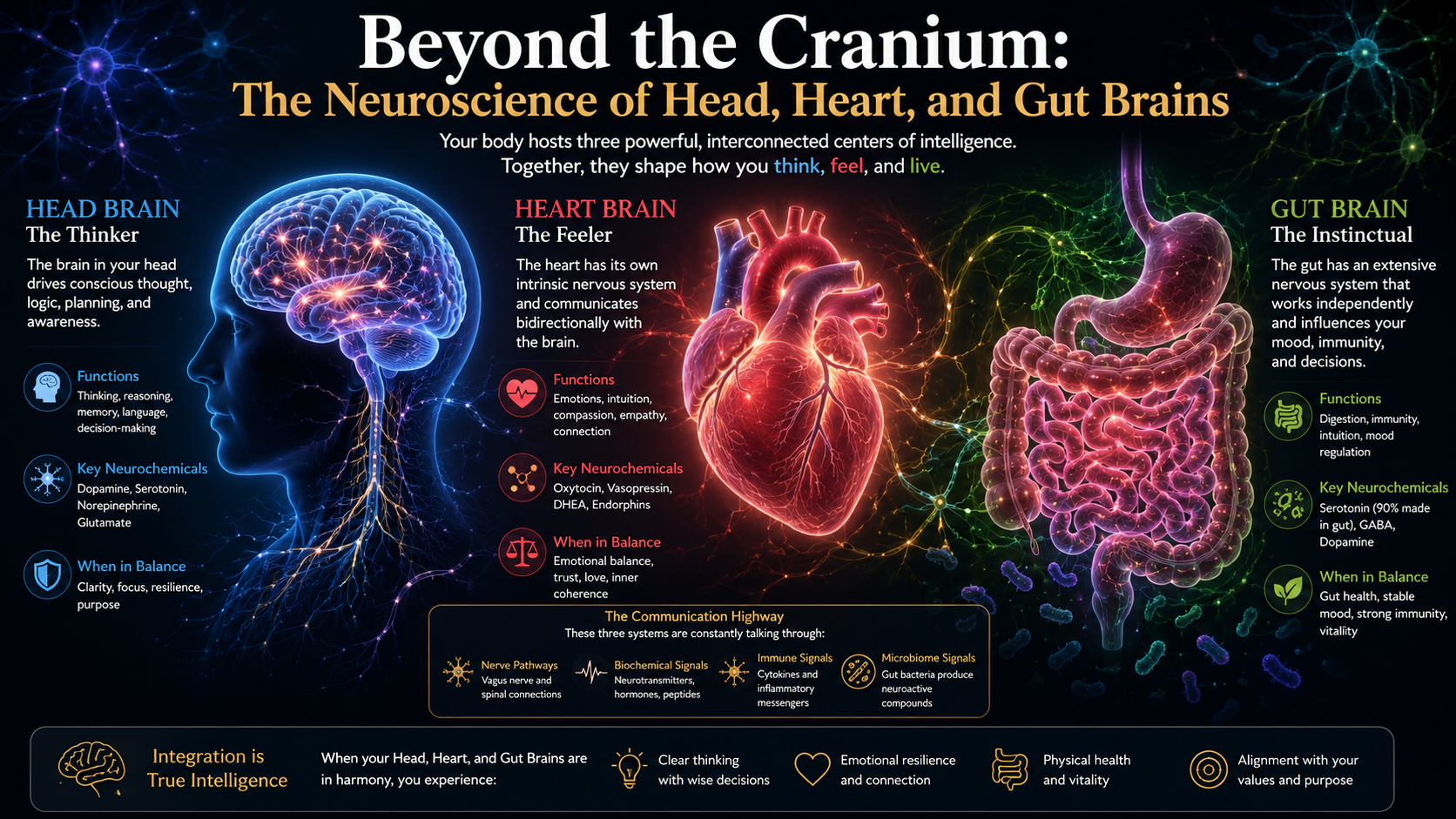
The Neuroscience of Head, Heart, and Gut Brains
We are often taught that intelligence resides solely in the head. However, a growing body of research in neurocardiology and neurogastroenterology reveals a more nuanced biological reality. Humans possess three distinct, semi-autonomous neural networks often referred to as the "three brains": the cephalic (head) brain, the cardiac (heart) brain, and the enteric (gut) brain. While not "brains" in the traditional sense of independent cognition, these are complex, information-processing nervous systems that communicate bidirectionally, profoundly influencing our thoughts, emotions, and behavior.
The Three Neural Processing Centers
The Head Brain (Cephalic Brain)
Key Functions: Executive function, goal-directed cognition, conscious thought, and objective data evaluation.
Peer-Reviewed Reference: The prefrontal cortex and associated networks are the primary neural substrates for these high-order functions.
The Heart Brain (Cardiac Brain)
Key Functions: Emotional experience, empathy, relational connection, and intuitive perception.
Peer-Reviewed Reference: The heart possesses an intrinsic cardiac nervous system (ICNS), a complex network of sensory and motor neurons that communicates with the brain via the brain-heart axis. This bidirectional communication influences emotional processing and higher cognition.
Select References:
McCraty, R., et al. (2004). Electrophysiological evidence of intuition: Part 1. The surprising role of the heart. The Journal of Alternative and Complementary Medicine.
Shaffer, F., & Ginsberg, J. P. (2017). An overview of heart rate variability metrics and norms. Frontiers in Public Health.
The Gut Brain (Enteric Brain)
Key Functions: Visceral reactions ("gut feelings"), instinct, core identity, and survival-based instincts.
Peer-Reviewed Reference: The enteric nervous system (ENS) is a mesh-like network of neurons embedded in the lining of the gastrointestinal tract. It is responsible for local control of digestion and operates largely independently, communicating with the head brain via the vagus nerve and other pathways.
Select References:
Mayer, E. A. (2011). Gut feelings: the emerging biology of gut–brain communication. Nature Reviews Neuroscience, 12, 453-466.
Gershon, M. D. (1998). The Second Brain. Harper Perennial.
Why This Matters: The Power of Neural Integration
The emerging scientific consensus from fields like Interpersonal Neurobiology (IPNB) suggests that optimal well-being and wiser decision-making are not a function of one brain dominating the others. Instead, they result from integration—the linkage of differentiated neural systems. When the cognitive logic of the head brain, the emotional intelligence of the heart brain, and the instinctual wisdom of the gut brain are aligned, we are equipped to make more holistic, resilient, and adaptive choices.